

Many people spend large parts of the day sitting — at work, during commuting, or while resting at home — without realizing how deeply this affects overall health.
Prolonged sitting does more than cause simple stiffness.
It influences circulation, joint lubrication, muscle strength, posture, and even long-term comfort.
This article explains how extended sitting impacts the body and offers gentle, practical methods to reverse these effects safely.
Why Sitting for Too Long Affects the Body
When the body stays in a seated position for long periods, several biological changes begin to occur.
Blood flow slows down, especially to the legs and lower back.
This reduced circulation makes it harder for oxygen and nutrients to reach muscles and joints.
Joint lubrication also decreases, because synovial fluid — the natural substance that helps joints glide smoothly — is stimulated by movement, not stillness.
Meanwhile, certain muscles become tight from holding the same position, while others weaken from lack of activation.
The hip flexors, for instance, shorten with prolonged sitting, while the glutes and lower back muscles can weaken over time.
These changes can lead to stiffness, discomfort, and an increased risk of pain when you eventually stand up or move.
How Prolonged Sitting Impacts Joint Health
Extended sitting limits the range of motion of the hips, knees, and spine.
Over time, this can create:
-
Tight hip flexors
-
Reduced lubrication in the knees
-
Increased pressure on the lower back
-
Slower circulation in the legs
-
Greater stiffness in the shoulders and upper back
The joints rely on gentle movement to stay nourished and healthy.
When movement is missing, these mechanical systems become less efficient, contributing to discomfort and reduced mobility.
The Subtle Postural Changes That Build Up Over Time
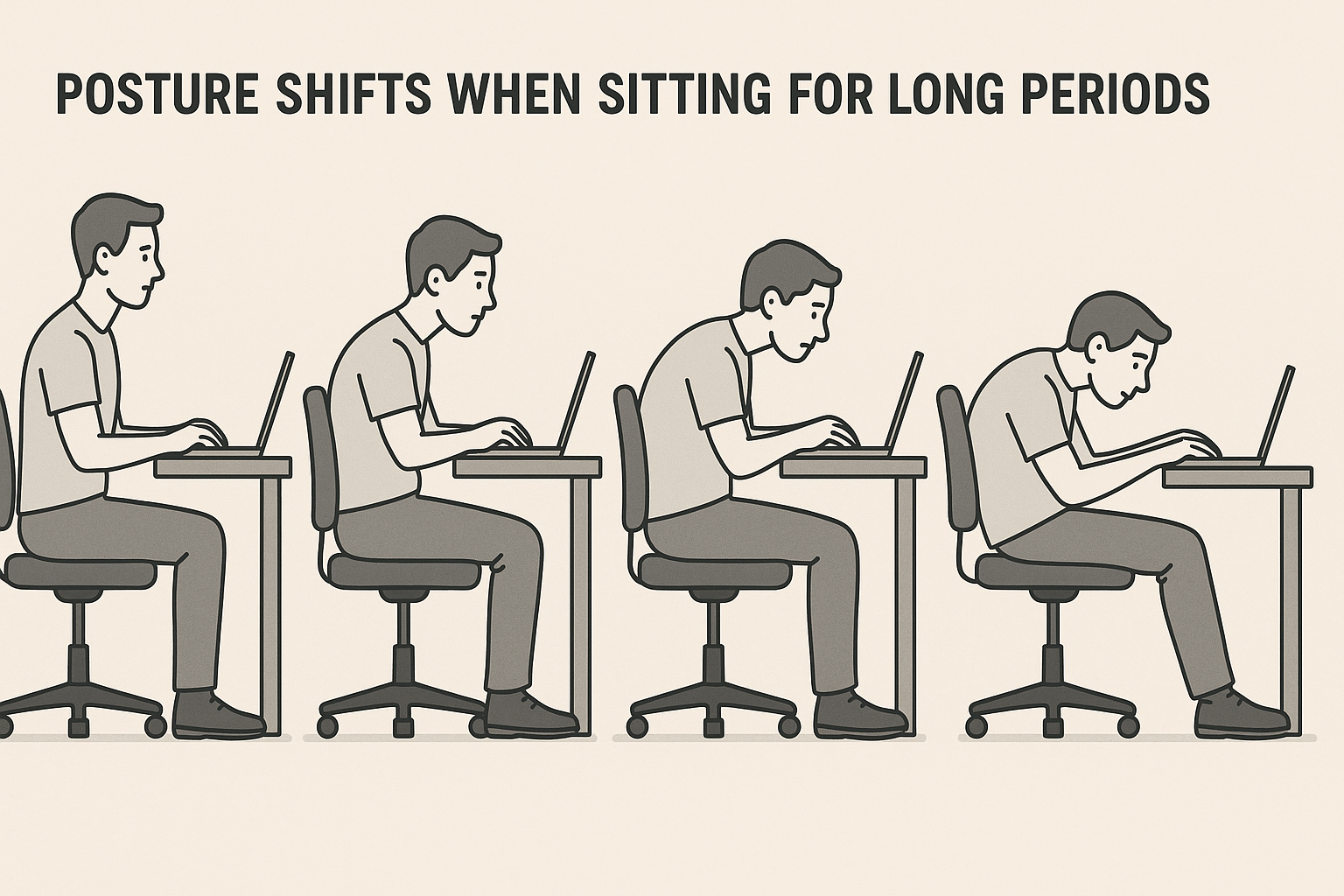
Many people do not notice how much their posture shifts when sitting for long periods.
Shoulders may round forward.
The neck may lean toward the screen.
The lower back may slump.
These small changes, repeated daily, can gradually strain the spine and surrounding muscles.
Over time, poor postural habits can contribute to:
-
Neck tension
-
Upper-back tightness
-
Lower-back discomfort
-
Reduced core stability
-
Muscle imbalances
Fortunately, these effects can be reversed with simple awareness and small adjustments.
Evidence from Scientific Research
Multiple studies in humans show that prolonged sedentary behavior — regardless of how physically active someone may be during leisure time — is associated with meaningful health risks.
A 2014 meta-analysis that examined dozens of studies found strong evidence linking sedentary behavior with increased risk of all-cause mortality, cardiovascular disease (CVD), type 2 diabetes, and metabolic syndrome. (PubMed)
A 2023 meta-analysis that included more than 1.4 million participants estimated that individuals who sit for long periods have an approximately 30% higher risk of fatal or non-fatal cardiovascular events compared to those who sit less.
Each additional hour of daily sitting was associated with about a 5% increase in risk. (ScienceDirect)
Other research shows that breaking up sitting time with brief bouts of light movement — such as standing, walking a few steps, or doing low-intensity activity — has immediate positive effects on cardiometabolic markers including blood pressure, blood glucose, and post-meal insulin response. (PMC)
In short, prolonged sitting is not just about feeling stiff or uncomfortable.
Spending long hours seated is a significant risk factor for overall, cardiovascular, and metabolic health.
How Light Movement Helps Reverse the Effects Safely
You do not need intense workouts to undo the impact of prolonged sitting.
Light, gentle movement performed consistently throughout the day can make a significant difference.
Even standing up for 30 seconds increases circulation.
Rotating your joints redistributes synovial fluid.
Gentle weight-shifting activates stabilizing muscles.
Small motions performed regularly help counteract stiffness, reduce pressure on the spine, and reactivate the muscles that tend to weaken with prolonged sitting.
This approach is safe for almost all age groups and does not require equipment.
Simple Daily Movements to Reduce the Impact of Sitting
Here are easy, realistic movements that can be done at home, at work, or while resting:
1. Neck Rolls
Slowly rotate the neck to release tension from long hours of screen time.
2. Shoulder Blade Squeezes
This helps counteract rounded shoulders and improves posture.
3. Seated Knee Extensions
Gentle extensions help lubricate the knees and support mobility.
4. Hip Shifts While Standing
A simple side-to-side weight shift reduces hip and lower-back stiffness.
5. Calf Raises
These stimulate circulation in the legs and reduce swelling.
6. Gentle Walking Breaks
Walking for just 2–3 minutes every hour helps reset your posture and improve comfort.
These small actions, accumulated throughout the day, gradually reverse the effects of prolonged sitting.
How to Build a Safe, Joint-Friendly Routine
A safe routine for reversing sitting-related discomfort focuses on short, consistent movements rather than long sessions.
Here is an approach that works well for most people:
Morning (2–3 minutes)
-
Light neck movements
-
Shoulder rolls
-
Gentle hip shifts
Midday (2–3 minutes)
-
Seated knee extensions
-
Calf raises
-
Slow, easy steps around the room
Evening (2–3 minutes)
-
Soft stretches for the hips
-
Thoracic spine rotations
-
Deep breathing to release tension
This routine supports the joints, improves posture, and helps reduce overall stiffness.
A Realistic Daily Plan to Reduce the Impact of Sitting
Many people know they should “move more,” but without a simple structure, the day passes and movement never happens.
This daily plan is designed for real life — whether you work at a desk, care for someone at home, or spend long hours sitting.
Morning (After Waking Up — 5 minutes)
-
Slow neck circles
-
Shoulder rolls
-
Gentle hip shifts
-
Light marching in place
-
Deep breathing with soft spine movements
During Work or Daily Tasks (Every 45–60 minutes — 1 minute)
Choose a reminder — phone call, email sent, or tea break.
Then do one of the following:
-
Stand and stretch overhead
-
Rotate ankles and wrists
-
Shift your weight gently
-
Take 10–15 slow steps
Midday Reset (3–5 minutes)
-
Seated knee extensions
-
Calf raises
-
Shoulder blade squeezes
-
Easy torso rotations
Evening (5 minutes)
-
Hip flexor stretches
-
Spine rotations
-
Light shoulder mobility
-
Ankle and wrist circles
Before Bed (Optional — 1 minute)
-
Knee-to-chest stretch
-
Gentle neck release
-
Slow deep breaths
This structure is simple enough to follow daily while offering meaningful benefits for joint comfort and overall well-being.
When You Should Seek Medical Guidance
While gentle movement is generally safe, certain symptoms require professional evaluation:
-
Persistent swelling
-
Redness or warmth around a joint
-
Severe stiffness lasting hours
-
Pain that increases with movement
-
Pain accompanied by fever
-
Difficulty standing or walking
-
Symptoms after an injury
A healthcare provider can ensure there are no underlying issues and help you choose movements appropriate for your needs.
A Healthier Way to Move Through Your Day
Prolonged sitting affects the body in many subtle ways, but these effects are not permanent.
With gentle, regular movement and simple awareness of posture, you can significantly reduce stiffness, improve comfort, and support long-term mobility.
Small adjustments throughout the day often have the greatest impact.
Your joints respond positively to motion — even the lightest kind.
Author Bio

Luca is a health and fitness writer and the creator of GetFitSafely.com, where he shares science-based guidance on safe movement, long-term joint health, and sustainable exercise habits.